
 Prabhu Ram
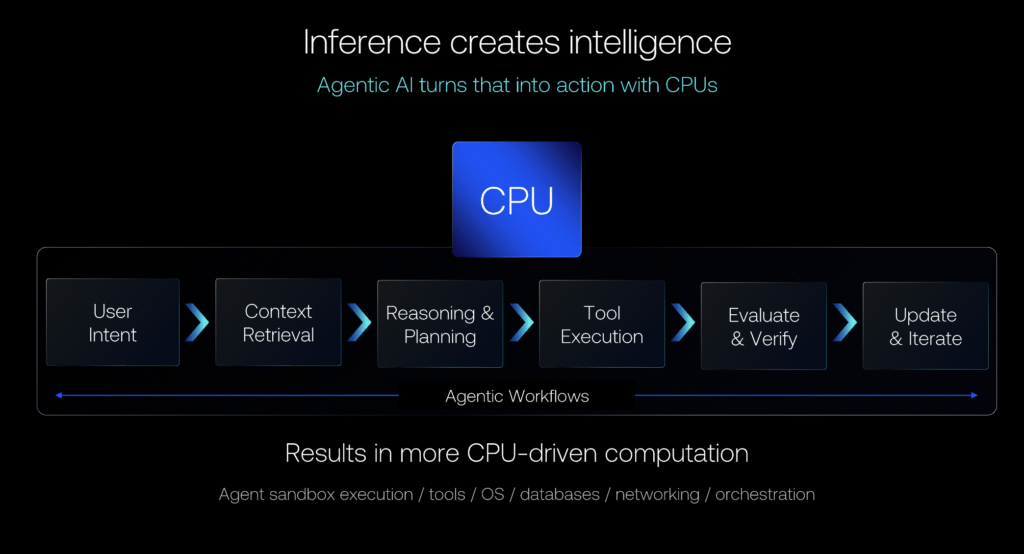
As agentic AI scales, it is moving beyond inference into reasoning, retrieval, tool calls and coordination with other agents, all orchestrated by CPUs.
More agents means more CPU demand. Arm is positioning to capture that shift.
What’s Driving Growth
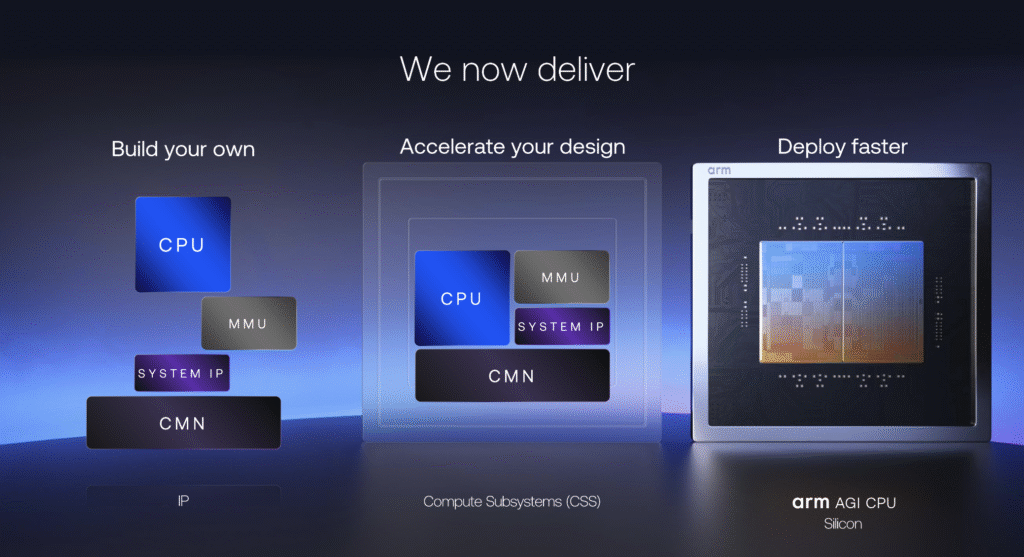
Neoverse CSS N4 targets customers building their own silicon. It supports up to 128 cores per die, LPDDR6 and PCIe Gen 7. Arm claims 2x performance, 1.25x performance per watt and 1.75x memory bandwidth versus N3.
These are the three levers agentic workloads increasingly stress: concurrency, bandwidth and I/O.
Arm AGI CPU targets customers wanting production-ready silicon without a custom design cycle. OpenAI, Meta, Cloudflare, Oracle, SAP, Lenovo, Supermicro and Verda are already building around it.
That customer mix spans model labs, cloud, software and OEMs, signalling ecosystem depth rather than a point product.
Deployment is also expanding. Google Cloud runs agent sandboxes on Axion-based GKE, Microsoft Azure uses Cobalt 200 for sandbox tool execution, NVIDIA’s Vera is designed for agentic workloads, and Volcano Engine is bringing Arm AGI CPU-powered agentic sandboxes to market.
Arm is also extending its Total Design silicon co-development model into Physical AI.
Why It Matters
The opportunity is not simply more CPU share in AI servers.
Agentic AI makes CPU capacity a shared dependency across accelerator-heavy workloads. More agents mean more orchestration, data movement and tool execution, regardless of the underlying accelerator.
That could decouple Arm’s growth from any single accelerator vendor’s cycle while strengthening its software ecosystem.
The Big Picture
AI infrastructure is fragmenting by workload. That favours platform vendors over single-product vendors.
Arm’s dual strategy, AGI CPU for deployment and CSS N4 for customisation, addresses both ends of that fragmentation.
The bigger prize is becoming the compute layer underneath agentic AI, regardless of which accelerator, cloud or model stack sits above it.


